Police forces across India stepped up their fight against cyber crime this week, with Gujarat completing a mass awareness drive, Bihar widening its preventive-detention law to cover digital offences, and Assam police arresting fresh suspects in coordinated raids. The developments, reported on July 21, 2026, show state governments treating cybercrime as an urgent law-and-order priority rather than a niche policing issue. Together, they affect millions of residents, students, and everyday internet users who remain the primary targets of online fraud.
Gujarat Completes A Major Cyber Crime Awareness Push
Gujarat Police announced that its She-Team and Cyber Cell units conducted 5,289 cyber crime awareness programmes during the first two weeks of a 28-day statewide campaign called Operation Surakshit Cyberspace. The initiative, running under Director General of Police G. S. Malik, focuses on protecting women and children from sextortion, deepfakes, cyberstalking, and online grooming. It combines community outreach with technology-based surveillance and rapid victim support.
How The Numbers Break Down
The campaign held 207 sessions in colleges and organised 109 public rallies to widen participation in digital safety efforts. In its second week, Gujarat Police shifted toward theme-based sessions, running 4,172 targeted programmes across districts. Social media safety accounted for 743 of these events, while 578 sessions addressed deepfake detection and 514 covered cyberstalking prevention specifically.
Officials also held 520 sessions under an “Anti-Sextortion Day” initiative, reflecting how cybercrime tactics have shifted toward emotionally manipulative scams. The scale of the drive suggests Gujarat Police expect prevention efforts to reduce the volume of digital fraud complaints reaching cyber cells across the state in the coming months.
Read more: Nintendo Data Breach

Bihar Widens Its Legal Response To Cyber Crime
Bihar has moved to expand the scope of its Goonda Act, a preventive-detention law traditionally used against habitual offenders, to formally bring paper leak cases and related cyber crime offences under its coverage. The change follows years of scrutiny over examination fraud in the state, including the widely reported NEET-UG paper leak controversy that exposed how organised networks use digital tools to steal and circulate exam material.
Bihar already enforces the Public Examinations Prevention of Unfair Means Act, which criminalises the use of fake websites and digital collusion by service providers during recruitment tests. Extending Goonda Act provisions to cyber crime gives police an additional tool to detain repeat offenders rather than relying solely on standard criminal proceedings. Other states, including Karnataka and Tamil Nadu, have taken similar steps in past years by bringing habitual cybercrime offenders under their own versions of the law.
Assam Police Continue Raids Against Cyber Crime Networks
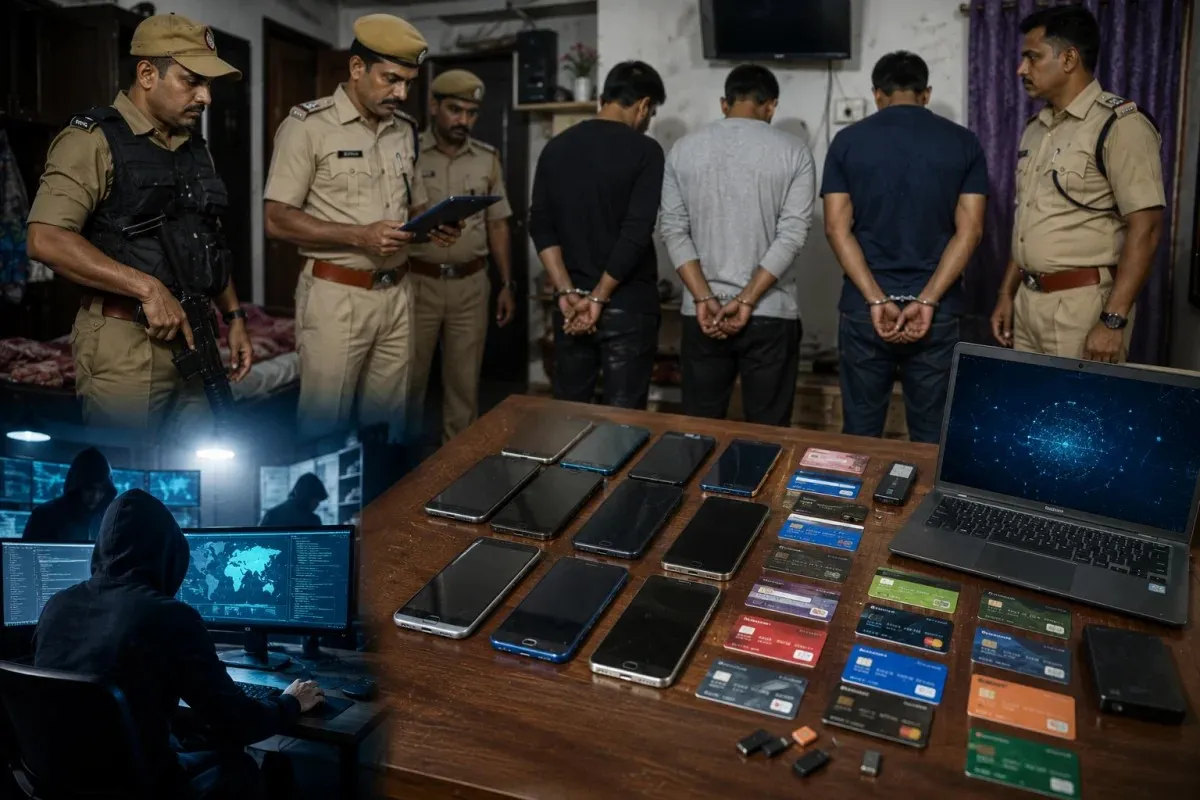
In Assam, a joint operation by Barpeta and Guwahati Police resulted in the arrest of three suspected cybercrime accused during coordinated raids across different locations in Guwahati. The suspects, identified as Amirul Ali, Paran Ali, and Moinuddin Ali, were detained during an operation led by Tarabari Police as part of an ongoing cybercrime investigation.
What Investigators Recovered
Officers seized 10 mobile phones and 13 debit cards from the accused during the raids. Investigators say the case remains active, with further inquiries expected to establish whether the group is linked to wider fraud networks operating across state lines. Assam has separately been strengthening its cyber crime infrastructure, including dedicated cyber police stations in recent years.
Read more: Nvidia Halves
Why Cyber Crime Keeps Rising Across India
Financial fraud, identity theft, and social media impersonation remain the most common categories driving cyber crime complaints nationwide. Investigators point to a few recurring patterns behind the surge:
- Fraudsters increasingly use fake job offers and exam-related scams to steal money from students and job seekers
- Mule bank accounts, often opened using stolen identities, are used to launder proceeds from cybercrime quickly
- Deepfake technology and AI-generated content are being used for sextortion and impersonation scams
- Cross-state and cross-border coordination among cybercrime networks makes single-jurisdiction policing difficult
- Victims frequently delay reporting incidents, allowing suspects time to withdraw or transfer stolen funds
What This Means For Internet Users
The parallel actions in Gujarat, Bihar, and Assam point to a broader national shift, with states pairing awareness campaigns against cybercrime with tougher legal consequences for repeat offenders. For residents, this means faster police response times are expected on complaints involving women and children, alongside wider public education efforts in schools and colleges.
Anyone encountering suspicious calls, messages, or job offers can report incidents directly through the National Cyber Crime Reporting Portal or by calling the national cyber crime helpline at 1930. Prompt reporting remains the most effective way to freeze stolen funds before they move through mule accounts.