Deploying IoT successfully takes more than good hardware; it takes the right strategy, architecture, and security foundation from day one. That’s where IoT consulting comes in. Whether you’re a startup building your first connected product or an enterprise scaling an industrial IoT rollout, an experienced IoT consultant or consulting firm helps you avoid costly missteps, choose the right technology stack, and get to market faster.
This guide breaks down everything you need to know: what IoT consulting services actually cover, the different types of consultancies available (strategy, security, product development, industrial), how the process works, and how to evaluate which IoT consulting company is the right fit for your business, whether you’re a startup, a growing team, or a large enterprise.
What Is IoT Consulting? (Definition & Overview)
IoT consulting is a professional advisory and technical service that helps businesses design, build, secure, and scale Internet of Things (IoT) solutions, from early strategy through deployment. Rather than just writing code or building hardware, an IoT consultant works alongside your team to define the right architecture, select the right technology stack, and reduce risk before a single line of firmware is written.
At its core, IoT consulting bridges three worlds that rarely live under one roof: hardware and embedded systems, cloud and data infrastructure, and business strategy. A strong IoT consultancy brings expertise across all three, so decisions made early, like connectivity protocols or cloud platform choice, do not become expensive problems later.
What Does an IoT Consultant Do?
An IoT consultant typically helps with strategy and roadmapping, which means defining what success looks like and how to get there. This usually includes technology and platform selection, such as choosing sensors, connectivity options like Wi-Fi, cellular IoT, LoRaWAN, or Bluetooth, and cloud platforms like Azure IoT or AWS IoT. It also covers architecture design, meaning how devices, gateways, cloud, and applications fit together, along with security and compliance guidance to protect devices and data from day one. Many consultants also assist with vendor and partner evaluation, helping you choose hardware manufacturers, chipset providers, and development partners; some also provide direct oversight or hands-on support during product development.
IoT Consulting vs. IoT Development: What’s the Difference?
This distinction matters because it is one of the most common points of confusion for buyers. IoT consulting focuses on strategy, architecture, and risk reduction, and its output looks like roadmaps, architecture documents, and recommendations. It typically happens before and alongside development, often as an ongoing advisory relationship. IoT development, on the other hand, is focused on actually building the product. Its output is working firmware, applications, and hardware, and it happens during and after the strategy phase, usually structured as a defined, build-focused project.
Many IoT consulting companies offer both. A typical path starts with consulting to de-risk the project, then transitions into hands-on product development once the strategy and architecture are solid.
Why Businesses Need an IoT Consultancy
IoT projects fail more often from strategic and architectural mistakes than from bad code. Common failure points include choosing the wrong connectivity for the environment, underestimating security requirements, or building a device that cannot scale past a pilot. An experienced IoT consultancy has typically seen these mistakes across many industries and use cases and can help you sidestep them, saving both time and budget compared to learning through trial and error in-house.
Our IoT Consulting Services
IoT consulting is not a single offering. It spans several specialized service types, and most businesses need a combination of them depending on where they are in their IoT journey. Below is a breakdown of the core services a well-rounded IoT consulting firm should offer.

IoT Strategy Consulting
IoT strategy consulting is the starting point for most engagements. It focuses on defining the business case for IoT, identifying the right use cases, setting measurable goals, and building a roadmap that aligns technology decisions with business outcomes. This phase answers questions like which problem IoT should solve, what a realistic budget and timeline look like, and how success will be measured. Getting strategy right early prevents costly pivots later in the project.
IoT Technology Consulting
Technology consulting goes one layer deeper than strategy. It involves evaluating and selecting the actual technology stack: sensors, microcontrollers, connectivity protocols, edge computing needs, and cloud infrastructure. A good technology consultant weighs tradeoffs between options like cellular versus LoRaWAN connectivity, or edge processing versus cloud-only processing, based on the specific environment and constraints of the project.
IoT Product Development Consulting
This service supports businesses building a new connected product from the ground up. It covers everything from initial concept and industrial design through prototyping, firmware development, and testing. Product development consulting is especially valuable for companies without in-house hardware or embedded engineering expertise, since it fills that gap without requiring a full internal team.
IoT Application Development Consulting
While product development consulting focuses on the physical device, application development consulting centers on the software layer: the mobile apps, dashboards, and cloud applications that let users and businesses interact with connected devices and their data. This includes designing user interfaces, building data visualization tools, and integrating with existing business systems.
Custom IoT Consulting
Custom IoT consulting refers to engagements tailored to a specific, often unconventional use case that does not fit neatly into a standard template. This is common in niche industries or when a business has unique constraints, such as extreme environmental conditions, strict regulatory requirements, or integration with legacy equipment that was never designed to be connected.
Industrial IoT (IIoT) Consulting
Industrial IoT consulting addresses the specific demands of manufacturing, energy, logistics, and other heavy industry environments. These projects typically involve harsher operating conditions, higher reliability requirements, and integration with existing industrial control systems (ICS) or SCADA infrastructure. IIoT consultants bring experience with the ruggedized hardware and specialized protocols these environments require.
IoT Security Consulting
Security consulting is one of the most critical and often overlooked parts of an IoT project. It covers device authentication, data encryption, secure firmware updates, and network security, along with compliance with relevant standards and regulations. Because connected devices significantly expand a business’s attack surface, security should be built in from the architecture stage rather than added on afterward.
Azure IoT Consulting
For businesses already using Microsoft’s ecosystem, Azure IoT consulting focuses specifically on designing and implementing solutions using Azure IoT Hub, Azure IoT Central, and related Microsoft services. This includes cloud architecture design, device provisioning, and integrating IoT data with other Azure-based business tools and analytics platforms.
IoT Product Design and Development Consulting
This combines industrial design with engineering consulting, helping businesses create connected products that are not only functional but also manufacturable, cost-effective, and user-friendly. It typically covers physical form factor design, component selection, and preparing a product for mass production.
Who We Help (IoT Consultancy for Every Business Stage)
Not every business needs the same kind of support from an IoT consultancy. The right engagement depends heavily on company size, existing technical resources, and where the project sits in its lifecycle.
IoT Consultancy for Startups
Startups typically need broad support since they often lack in-house hardware, firmware, or IoT-specific engineering talent. A consultancy working with startups usually helps validate the product concept, build a minimum viable product (MVP), and make early architecture decisions that will not become expensive to change later. Cost efficiency and speed to a working prototype tend to matter most at this stage, since startups are often working toward a funding milestone or early customer validation.
IoT Consultancy for Enterprises
Enterprises usually come to an IoT consultancy with different priorities. They may already have internal engineering teams, but need specialized expertise for a specific initiative, help navigating complex integrations with legacy systems, or support scaling a successful pilot across many locations or product lines. Security, compliance, and the ability to manage large-scale deployments are typically bigger concerns here than at the startup stage, since enterprise IoT rollouts often involve thousands of devices and multiple stakeholders across departments.
IoT Consultancy for General Businesses and Growing Teams
Between these two extremes sit established businesses that are mature but still relatively new to IoT. These companies often need help translating a business goal, such as remote equipment monitoring or predictive maintenance, into a practical technical plan. They usually benefit most from a consultant who can act as a technical partner throughout the process rather than requiring a single, narrow deliverable, since the internal team may not yet have the experience to manage an IoT project independently.
Our IoT Consulting Process
While every engagement is shaped around the specific goals of the business, most IoT consulting projects follow a similar arc from initial discovery through long-term support. Understanding this process helps set realistic expectations for timeline, cost, and deliverables at each stage.

Discovery and Strategy Workshop
Every engagement should start with a discovery phase, where the consultant works closely with your team to understand the business problem, existing infrastructure, budget constraints, and success criteria. This usually takes the form of structured workshops or interviews with key stakeholders. The output is typically a clear problem statement, a set of prioritized use cases, and an initial roadmap that guides everything that follows. Skipping or rushing this phase is one of the most common reasons IoT projects go over budget later.
Architecture and Technology Selection
Once the strategy is defined, the consultant moves into designing the technical architecture. This involves selecting connectivity protocols, choosing between edge and cloud processing, evaluating hardware components, and picking a cloud platform such as Azure IoT or AWS IoT. Decisions made here have long-term consequences, since switching connectivity types or cloud providers after development has started is often expensive and time-consuming.
Prototyping and Product Development
With architecture in place, the project moves into building a working prototype. This phase typically includes hardware design or selection, firmware development, and building the initial version of any companion applications or dashboards. The goal is usually to produce a functional proof of concept that can be tested in real conditions before committing to full-scale production or deployment.
Security and Compliance Review
Before scaling beyond a pilot, a thorough security and compliance review should take place. This includes testing device authentication, encryption, and update mechanisms, as well as confirming the solution meets any relevant industry regulations. Because IoT devices are often deployed in the field for years without close supervision, addressing security gaps at this stage is far cheaper than dealing with a breach after full deployment.
Deployment and Scaling Support
The final stage involves rolling the solution out at full scale, whether that means shipping a consumer product, deploying sensors across a factory floor, or installing equipment across multiple enterprise sites. Many consultancies continue to provide support after launch, helping monitor performance, manage software updates, and troubleshoot issues as the deployment grows. This ongoing relationship often becomes especially valuable as a business expands into new locations or product lines and needs the architecture to scale smoothly.
Benefits of Hiring an IoT Consulting Firm
Bringing in an outside IoT consulting firm is not just about filling a skills gap. When done well, it changes the entire risk and cost profile of a project. Below are the main advantages businesses see when they work with an experienced consultancy rather than trying to build IoT expertise entirely in-house.
Faster Time to Market
An experienced IoT consultant has already solved many of the problems your team is about to encounter for the first time. Instead of spending months researching connectivity options, evaluating cloud platforms, or learning the quirks of industrial hardware, a consultancy brings that knowledge from day one. This typically significantly compresses the timeline from initial concept to working prototype, since the team is not learning as it goes.
Reduced Technical Risk
IoT projects fail more often because of poor early decisions than because of poor execution. A consultant who has worked across multiple IoT deployments can spot architectural weaknesses, security gaps, or scalability problems before they become embedded in the product. This kind of foresight is difficult to replicate with a first-time internal team, simply because it comes from pattern recognition built across many past projects rather than from any single project alone.
Access to Cross-Domain Expertise
Very few in-house teams have deep expertise across hardware, embedded firmware, cloud infrastructure, data engineering, and security all at once. IoT consulting firms typically employ specialists across these domains, meaning a business gets access to a broad team of experts without having to hire and manage each specialty separately. This is particularly valuable for companies that only need this range of expertise for the duration of a single project rather than on an ongoing basis.
Cost Optimization Compared to In-House Teams
Building a full in-house IoT team, covering hardware engineers, firmware developers, cloud architects, and security specialists, is expensive and slow, especially for a single project. Engaging a consultancy allows a business to access that same range of expertise on a project basis, paying for the specific skills needed at each stage rather than carrying the overhead of a large permanent team. For startups and mid-sized businesses in particular, this often makes the difference between a project being financially viable or not.
Industries and Use Cases We Serve
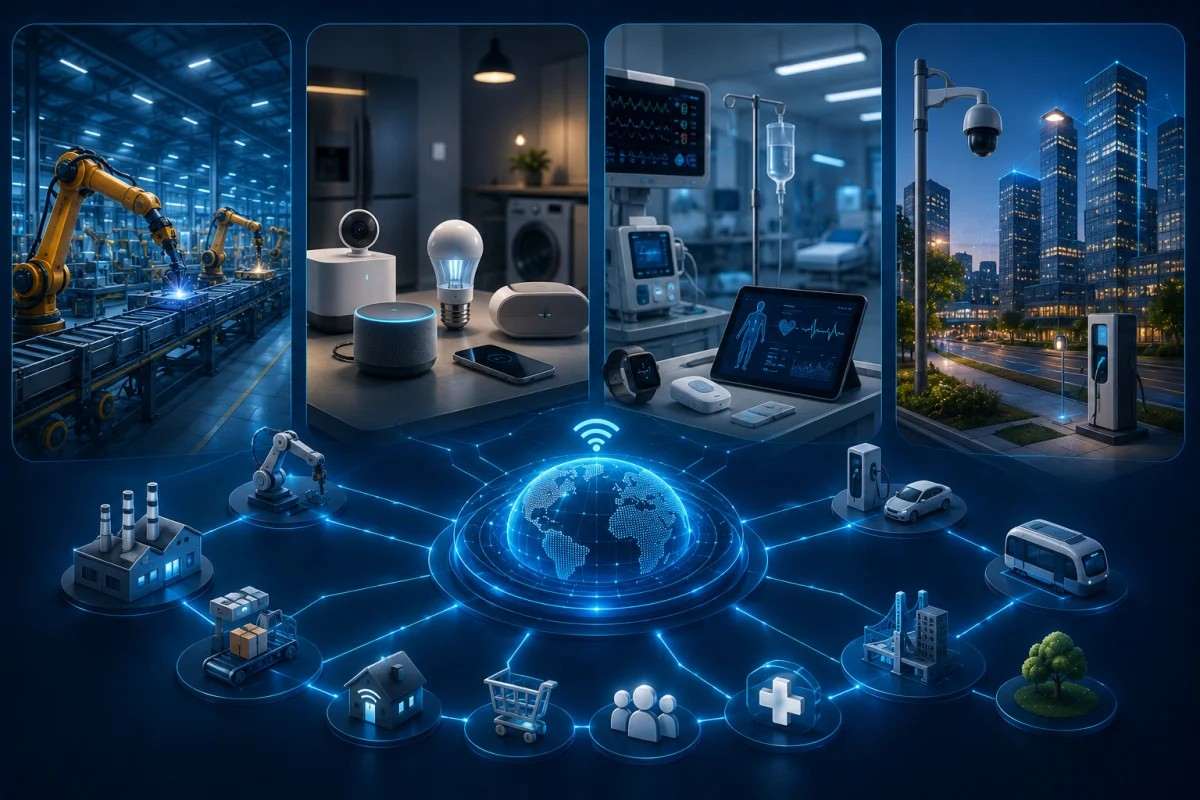
IoT is not a single, uniform technology. What works for a wearable consumer device looks nothing like what works on a factory floor or inside a hospital. Below are the primary industries where IoT consulting delivers the most value, along with the kinds of use cases typical in each.
Industrial and Manufacturing IoT
In manufacturing and industrial settings, IoT is most often used for predictive maintenance, equipment monitoring, and process automation. Sensors track vibration, temperature, and performance data on machinery to flag problems before they cause costly downtime. These environments usually demand ruggedized hardware, reliable connectivity in challenging physical conditions, and integration with existing industrial control systems that were often not originally designed to be networked.
Smart Product and Consumer IoT
This category covers connected consumer products such as smart home devices, wearables, and connected appliances. The priorities here tend to differ sharply from industrial use cases. Consumer IoT consulting usually emphasizes low production cost, intuitive user experience, battery efficiency, and app design, since the end user is typically a non-technical consumer rather than a trained operator.
Healthcare and Medical Device IoT
Connected medical devices and remote patient monitoring systems fall under some of the strictest regulatory requirements of any IoT category. Consulting in this space involves navigating compliance frameworks, ensuring data privacy for sensitive health information, and building the reliability and security needed when a device failure could directly affect patient safety.
Smart Buildings and Infrastructure
This use case covers connected systems for energy management, access control, occupancy monitoring, and environmental controls within commercial or residential buildings. These projects often involve integrating with existing building management systems, and success is usually measured by energy savings, operational efficiency, and tenant or occupant experience.
Why Choose Us as Your IoT Consulting Company
With so many IoT consulting firms in the market, choosing the right partner often comes down to depth of experience, breadth of technical coverage, and a track record of turning strategy into working products. Here is what sets our approach apart.
Our IoT Consultants’ Expertise
Our team brings experience across the full IoT stack, spanning hardware and embedded systems, cloud architecture, application development, and security. Rather than handing a project off between disconnected specialists, our consultants work together across these disciplines, so decisions made in one area, such as hardware selection, are always made with downstream implications for cloud architecture and security already in mind.
Technology Partners and Platforms
We work across the major IoT platforms and cloud ecosystems, including Azure IoT and AWS IoT, along with a range of connectivity standards and hardware providers. This means our recommendations are shaped by what best fits your specific use case and constraints, rather than being limited to a single vendor relationship or platform preference.
Proven Results
Our track record spans projects across industrial, consumer, healthcare, and smart infrastructure applications, giving us pattern recognition that comes only from having navigated similar challenges before. That experience translates directly into fewer costly surprises and a smoother path from initial strategy to a scaled, working deployment.
How to Choose the Right IoT Consultancy (Comparison Framework)
Selecting an IoT consulting partner is a decision with long-term consequences, since the architecture and vendor choices made early in a project are often difficult and expensive to reverse later. The following comparisons are meant to help clarify the tradeoffs involved.
In-House Team vs. IoT Consulting Firm
Building an in-house IoT team gives a business full control. It retains institutional knowledge internally over time, but it requires hiring across multiple specialties, including hardware, firmware, cloud, and security, which is slow and expensive, especially for a single project. Working with an IoT consulting firm instead provides immediate access to a broad range of expertise without the overhead of permanent hires, and it is typically faster to get started. The tradeoff is that some of the deep contextual knowledge gained during the project may need to be transferred back to the internal team once the engagement ends, so a clear knowledge transfer plan should be part of any consulting agreement.
Boutique IoT Consultants vs. Large Consulting Firms
Boutique IoT consultancies tend to offer more hands-on involvement from senior consultants, greater flexibility, and often more competitive pricing, since they usually carry less organizational overhead. Large consulting firms may offer broader bench strength and more established processes, but projects can sometimes be handed to more junior team members, and pricing is typically higher. The right choice usually depends on project complexity and scale. Smaller, well-defined projects often benefit from the direct attention a boutique firm provides. At the same time, very large, multi-site enterprise rollouts may need the resourcing depth a larger firm can offer.
Questions to Ask Before Hiring an IoT Consultant
Before committing to an engagement, it is worth asking a consultancy about their experience with similar use cases and industries, which platforms and technologies they specialize in, and how they structure their engagement from strategy through deployment. It is also important to understand who will actually be doing the work day-to-day, how security and compliance are addressed throughout the process, and what ongoing support looks like once a product moves from prototype to full deployment. A consultancy that can answer these questions clearly and specifically, rather than in vague generalities, is usually a strong signal of real experience.
Frequently Asked Questions
How Much Does IoT Consulting Cost?
IoT consulting costs vary significantly depending on the scope of the engagement, the complexity of the technical requirements, and the consultancy’s experience level. A short strategy engagement focused only on roadmapping and technology selection typically costs far less than a full engagement that includes prototyping, product development, and ongoing deployment support. Most consultancies price projects based on scope rather than a flat rate, so getting an accurate estimate usually requires an initial discovery conversation about the project’s specific goals.
How Long Does an IoT Consulting Engagement Take?
Timelines depend heavily on the stage of the project. A strategy and discovery phase alone often takes a few weeks, while building a working prototype can take several months depending on hardware complexity. Full deployments, especially in industrial or enterprise settings involving many devices or locations, can extend over a year when phased rollouts and scaling support are included. Businesses with a clear, narrow use case tend to move through the process faster than those still exploring what problem IoT should solve.
Do I Need an IoT Consultant or an IoT Developer?
This depends on where a project currently stands. If the business goal, technology approach, and architecture have not yet been defined, an IoT consultant is usually the right starting point, since their focus is on reducing risk and setting direction before any building begins. If the strategy is already clear and the primary need is hands-on engineering to build the product, an IoT developer may be sufficient. Many businesses end up needing both, often starting with consulting and transitioning into development once the plan is solid.
What Industries Benefit Most From IoT Consulting?
While IoT consulting is used across nearly every industry, it tends to deliver the most value in sectors where connected devices directly affect safety, efficiency, or revenue. This includes industrial and manufacturing settings focused on predictive maintenance, healthcare applications involving patient monitoring, and smart building or infrastructure projects tied to energy efficiency. Consumer product companies also benefit significantly, particularly when building a new connected product without existing in-house hardware expertise.