The Internet of Things has moved from a buzzword to a business necessity, but turning an idea into a working, secure, and scalable IoT solution is far from simple. Whether you’re building a smart wearable, an industrial monitoring system, or a connected mobile app, IoT development brings together hardware, firmware, cloud infrastructure, and software in ways traditional development never has to.
This guide breaks down everything you need to know: what IoT development actually involves, the different types of services available, how the process works step by step, and how to choose the right team, whether that’s an in-house developer, a specialized agency, or a full-scale IoT development company. Along the way, we’ll cover industry-specific considerations, popular platforms and dev kits, realistic costs and timelines, and the challenges most teams run into so you can avoid them.
What Is IoT Development?
IoT development is the process of designing, building, and deploying connected systems that enable physical devices to collect data, communicate with one another, and act on that information without constant human input. It combines several disciplines at once, including embedded engineering, cloud computing, mobile and web application development, and network security, all working together to turn a simple sensor or device into part of a larger intelligent ecosystem. At its core, IoT development is what makes a smart thermostat learn your schedule, a fitness tracker sync your heart rate to an app, or a factory sensor alert a technician before a machine fails.
The goal is always the same: connect the physical world to digital systems so that data can be captured, analyzed, and used to trigger meaningful action. Because IoT spans so many layers of technology, companies seeking IoT development services are usually not just hiring a single developer. They are assembling a solution spanning hardware selection, firmware programming, cloud architecture, and user-facing software, so understanding each component matters before starting a project.
How IoT Development Works (Devices, Connectivity, Cloud, Apps)
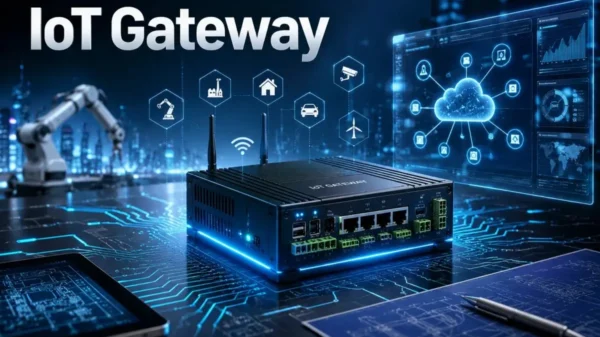
Every IoT solution is built on four interconnected layers. The first is the device layer, which includes the physical hardware such as sensors, microcontrollers, or wearables that gather raw data from the real world. The second is the connectivity layer, responsible for transmitting that data via protocols such as Wi-Fi, Bluetooth, cellular networks, or low-power options like LoRaWAN and Zigbee, depending on range and power requirements.
Once data leaves the device, it moves into the cloud layer, where it is stored, processed, and often analyzed using machine learning models to detect patterns or anomalies. Finally, the application layer is where users interact with the system, typically through a mobile app or web dashboard that displays insights, sends alerts, or allows remote control of connected devices. A skilled IoT development team designs all four layers to work seamlessly together, since a weakness in any single layer, whether it is unreliable connectivity or a poorly optimized cloud backend, can compromise the entire solution.
IoT Development vs Traditional Software Development
While IoT development overlaps with traditional software development, the two are far from identical. Traditional software typically runs on a single platform such as a server, desktop, or smartphone, with predictable resources and a stable operating environment. IoT development, on the other hand, must account for constrained hardware, intermittent connectivity, power limitations, and physical environmental factors that rarely apply to conventional apps.
IoT developers also need to consider long-term device lifecycle management, since connected products often remain in the field for years and require remote firmware updates, security patches, and ongoing monitoring long after initial deployment. This adds a layer of complexity that most traditional software projects never encounter, making specialized IoT development expertise essential rather than optional.
Key Components of an IoT Solution
A complete IoT solution generally includes five essential components working in tandem. Hardware forms the physical foundation, including sensors, actuators, and microcontrollers that interact directly with the environment. Firmware is the low-level software embedded directly on the device, controlling how it behaves and communicates. Connectivity infrastructure determines how devices transmit data reliably and securely, while cloud platforms handle data storage, processing, and integration with other business systems.
Finally, the application layer, whether a mobile app, a web dashboard, or both, provides end users with a way to monitor and control the entire system. Understanding these components helps businesses evaluate IoT development companies more effectively, since a provider strong in app development but weak in embedded firmware may not be equipped to deliver a fully functioning end-to-end solution.
Types of IoT Development Services
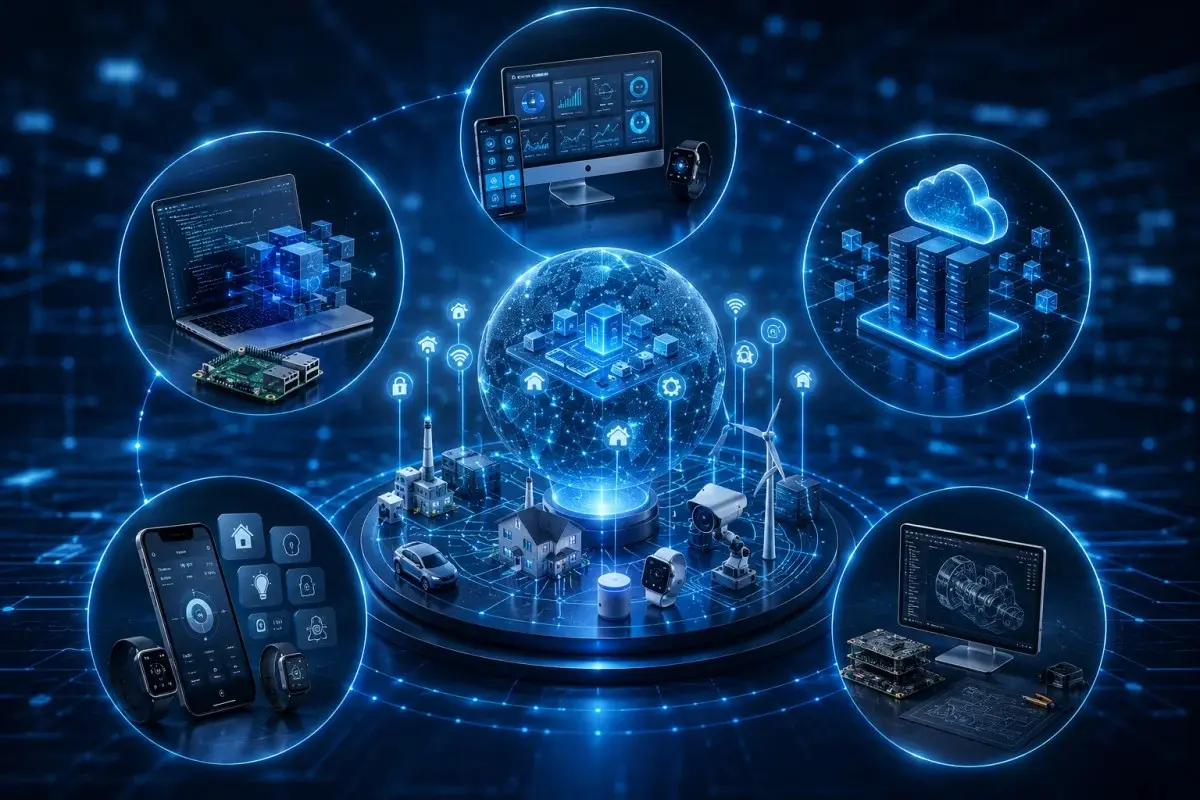
IoT development is not a single service but a collection of specialized offerings that address different parts of a connected product. Businesses exploring this space often need more than one type of service to bring a complete solution to life, which is why understanding the distinctions between them helps in choosing the right partner or team for the job.
IoT Application Development
IoT application development focuses on building the software layer that users interact with, whether that is a mobile app, a web-based dashboard, or both. This service involves designing interfaces that display real-time data from connected devices, allow remote control, and translate raw sensor readings into meaningful insights. A well-built IoT application also handles notifications, historical data trends, and user permissions, especially when multiple people or teams need access to the same connected system.
IoT Software Development
IoT software development encompasses a broader scope than applications alone, extending to backend systems, application programming interfaces, and business logic that power the entire IoT ecosystem. This includes the middleware that connects devices to the cloud, data processing pipelines, and integration with existing enterprise software such as customer relationship management or inventory systems. Strong IoT software development ensures that data flows smoothly from the device to the business tools that rely on it.
IoT Platform Development
IoT platform development involves building the underlying infrastructure that supports device management, data ingestion, and analytics at scale. Rather than focusing on a single app or product, platform development creates a foundation that can onboard thousands of devices, manage firmware updates remotely, and provide the tools needed to monitor an entire fleet of connected products. This service is especially valuable for companies planning to launch multiple IoT products or scale rapidly over time.
IoT Mobile App Development
IoT mobile app development narrows in specifically on smartphone and tablet experiences, since most consumers and many business users interact with their connected devices primarily through mobile apps. This requires expertise in both native and cross-platform development along with a deep understanding of how to maintain a stable connection between the app and physical hardware, even when network conditions are inconsistent. Battery efficiency and background data syncing are particularly important considerations in this area.
Custom IoT Development Services
Custom IoT development services are tailored solutions built around a specific business need rather than a one-size-fits-all product. These services often involve a combination of hardware selection, custom firmware, unique cloud architecture, and specialized applications designed for a particular industry or use case. Businesses with highly specific requirements, such as unusual environmental conditions or proprietary hardware, typically turn to custom development to ensure the final solution fits their exact operational needs rather than adapting a generic template.
How to Develop an IoT Application (Step-by-Step Process)
Building an IoT application from the ground up involves a structured sequence of stages, each building on the last. Skipping or rushing any one of these steps often leads to costly rework later, which is why experienced IoT development teams follow a disciplined process rather than jumping straight into coding.
Defining Requirements and Use Cases
Every successful IoT project starts with a clear understanding of the problem it needs to solve. This stage involves identifying the specific use case, whether it is remote equipment monitoring, asset tracking, or a consumer wearable, and outlining exactly what data needs to be collected and what actions the system should trigger. Teams also need to define target users, expected device volume, and any regulatory or industry-specific requirements, since these factors shape nearly every subsequent technical decision.
Hardware Selection and Prototyping
Once requirements are clear, attention shifts to choosing the right hardware components, including sensors, microcontrollers, and connectivity modules that fit the project’s power, size, and budget constraints. Development boards and kits are commonly used at this stage to build early prototypes and validate core functionality before committing to custom hardware. Prototyping allows teams to test assumptions quickly and identify potential design flaws while changes are still inexpensive to make.
Firmware and Embedded Software Development
With hardware in place, developers write the firmware that controls how the device behaves, processes sensor input, and communicates with other layers of the system. This stage requires careful attention to power efficiency and processing constraints, since embedded devices typically have far less computing power than smartphones or servers. Firmware must also be designed with future updates in mind, enabling bugs to be fixed and features added remotely after deployment.
Cloud Integration and Data Management
As devices begin generating data, that information needs a reliable path to the cloud where it can be stored, processed, and analyzed. This stage involves setting up cloud infrastructure, defining how data is structured and secured, and building the pipelines that move information from thousands of devices without bottlenecks or data loss. Proper cloud architecture at this point directly determines how well the system will scale as more devices come online.
Mobile or Web App Development for IoT
With data flowing into the cloud, the next step is building the interface that lets users make sense of it. This involves designing dashboards, alerts, and controls that translate raw data into clear, actionable information. Careful attention is given to how the app maintains a stable connection with devices, handles intermittent connectivity, and updates in real time without draining battery life or overwhelming users with unnecessary notifications.
Testing, Security, and Deployment
Before launch, the entire system undergoes rigorous testing across every layer, from firmware stability to app performance under real-world network conditions. Security testing is especially critical in IoT, since connected devices are common targets for cyberattacks and a single vulnerability can compromise an entire network. Once testing is complete, the solution is deployed, though the work does not end there, since ongoing monitoring and remote updates remain essential for as long as the devices stay in use.
Choosing an IoT Development Company
Selecting the right partner for an IoT project is often the single most important decision a business makes in the entire development journey. Because IoT solutions span hardware, firmware, cloud infrastructure, and applications, the company or team chosen needs to demonstrate strength across all these areas rather than excelling in just one.

What to Look for in an IoT Development Company
A strong IoT development company should be able to show proven experience across the full technology stack, not just app design or backend development in isolation. It helps to review case studies or past projects that closely resemble the intended use case, since experience with wearables differs significantly from experience with industrial sensor networks. Communication style and project management approach also matter greatly, particularly for businesses new to IoT that need a partner willing to explain technical trade-offs in plain language.
Security expertise deserves special attention during evaluation, since connected devices introduce risks that traditional software does not face. A capable partner should be able to explain how they handle device authentication, data encryption, and firmware update security without hesitation, as vague or dismissive answers in this area are often a warning sign.
In-House Team vs Outsourced IoT Developers
Businesses generally face a choice between building an internal team or outsourcing to an established IoT development company, and each path carries distinct tradeoffs. An in-house team offers tighter control over the roadmap and deeper institutional knowledge over time, but building this team from scratch is expensive and slow, particularly because IoT talent spanning embedded systems, cloud architecture, and mobile development is difficult to find and retain.
Outsourcing to a specialized company allows a business to tap into a team with cross-disciplinary expertise, often resulting in a faster path to launch. The trade-off is reduced day-to-day control and greater reliance on clear documentation and communication to keep the project aligned with business goals. Many companies choose a hybrid approach, keeping strategic oversight in-house while outsourcing specialized technical execution to an experienced development partner.
Top Qualities of IoT Application Development Companies in the USA
Companies searching for an IoT application development company in the USA typically look for a combination of technical depth and industry-specific experience. Familiarity with US regulatory requirements, particularly in sectors such as healthcare and industrial manufacturing, is often a deciding factor, since compliance failures can be costly and time-consuming to correct after the fact.
Strong US-based IoT development companies also tend to offer clearer, time zone-aligned communication and a better understanding of local data privacy expectations, which can simplify collaboration for businesses that prioritize close, real-time coordination throughout the project.
Questions to Ask Before Hiring an IoT Developer
Before committing to a developer or development company, it helps to ask direct questions about their experience with similar projects, their approach to security, and how they handle firmware updates after deployment. It is also worth asking how they manage scope changes, since IoT projects frequently evolve as prototypes reveal new technical realities.
Asking for references from past clients, particularly those in a similar industry, often reveals more about a company’s reliability and communication style than a portfolio alone can show. A confident, experienced IoT developer should welcome these questions rather than treat them as an inconvenience.
IoT Development by Industry
While the fundamentals of IoT development remain consistent across projects, the specific challenges and priorities shift significantly depending on the industry for which a solution is built. Understanding these differences helps businesses set realistic expectations and choose a development partner with relevant domain experience.
Medical and Wearable IoT Development
Medical IoT development operates under some of the strictest requirements of any connected technology sector, since devices often handle sensitive patient data and, in many cases, directly influence health outcomes. Wearable devices that monitor heart rate, blood oxygen, or glucose levels must be engineered for both accuracy and reliability, as inconsistent readings can lead to poor health decisions or missed warning signs.
Regulatory compliance plays a central role in this space, with developers needing to navigate data privacy laws and, depending on the device’s function, potential medical device certification requirements. Battery life and comfort are also critical design considerations, since wearable medical devices are often worn continuously for extended periods, making power efficiency just as important as data accuracy.
Industrial IoT (IIoT) Development
Industrial IoT development focuses on connecting machinery, equipment, and production systems to enable real-time monitoring, predictive maintenance, and operational efficiency at scale. Unlike consumer devices, industrial sensors often operate in harsh environments involving extreme temperatures, vibration, dust, or moisture, requiring hardware built specifically to withstand these conditions over long deployment periods.
Downtime in industrial settings can be extremely costly, placing heavy emphasis on system reliability and the ability to detect equipment issues before they cause failure. Integration with existing industrial systems, such as manufacturing execution software or supply chain platforms, is also a common requirement, since IIoT solutions rarely operate in isolation from a company’s broader operational technology.
Consumer and Smart Home IoT Development
Consumer and smart home IoT development prioritizes ease of use above almost everything else, since everyday users expect devices to work intuitively without technical setup or troubleshooting. Products in this category, including smart thermostats, security cameras, and connected appliances, need to deliver a seamless out-of-box experience while still maintaining strong security, as consumer devices are frequently targeted due to their large-scale deployment and often inconsistent update habits.
Interoperability is another major focus in this space, since consumers increasingly expect their smart home devices to work together regardless of brand, often through shared standards or platforms. Developers working in this space must balance simplicity for the end user with the underlying complexity needed to support reliable, secure, cross-device communication.
IoT Development Platforms and Tools
Choosing the right platforms and tools can significantly influence how quickly an IoT product moves from concept to market and how easily it scales once deployed. This stage of development often determines whether a team builds efficiently using existing infrastructure or spends unnecessary time recreating capabilities that already exist in established platforms.
Popular IoT Application Development Platforms
IoT application development platforms provide the underlying infrastructure needed to connect devices, manage data, and build applications without having to start entirely from scratch. These platforms typically offer device management dashboards, data storage, and prebuilt tools for handling communication between hardware and cloud systems, which can dramatically reduce development time compared to building everything in-house.
Major cloud providers offer their own IoT platforms with strong integration into broader cloud ecosystems, making them a common choice for businesses that already rely on those providers for other services. Other platforms focus specifically on IoT use cases, offering more specialized tools for device provisioning, over-the-air updates, and analytics tailored to connected products. The right choice often depends on factors like expected device volume, budget, and whether the business needs deep customization or prefers a more guided, out-of-the-box experience.
IoT Development Boards and Kits (ESP32, M5Stick, and More)
Development boards and kits play a central role in the early stages of building an IoT product, allowing teams to prototype and test ideas before committing to custom hardware. Boards like the ESP32 have become widely popular due to their built-in wireless connectivity, low cost, and strong community support, making them a practical starting point for a wide range of projects, from simple sensor readings to more complex connected devices.
Compact kits, such as those built around small-form-factor boards like the M5Stick series, are especially useful for wearable prototypes or projects with limited space. These kits often come with built-in displays, buttons, and sensors, allowing developers to test functionality quickly without needing to source and wire individual components separately. Using established development boards during the prototyping phase helps teams validate core functionality and catch design issues early, well before investing in custom-manufactured hardware.
Choosing the Right Dev Kit for Your Project
Selecting an appropriate development kit depends heavily on the project’s specific requirements, including power constraints, required connectivity type, and available processing power. A project that only needs basic Bluetooth communication has very different hardware needs than one that requires cellular connectivity or is heavy on device data processing, so matching the kit to the actual technical requirements helps avoid wasted time and unnecessary cost during prototyping.
It also helps to consider the long-term path from prototype to production when choosing a development kit, since some boards are well suited for testing but not intended for final product deployment. Teams that plan ahead for this transition, rather than treating prototyping and production as entirely separate phases, tend to move through development more smoothly and avoid redesigning core functionality later in the process.
Costs and Timelines for IoT Development
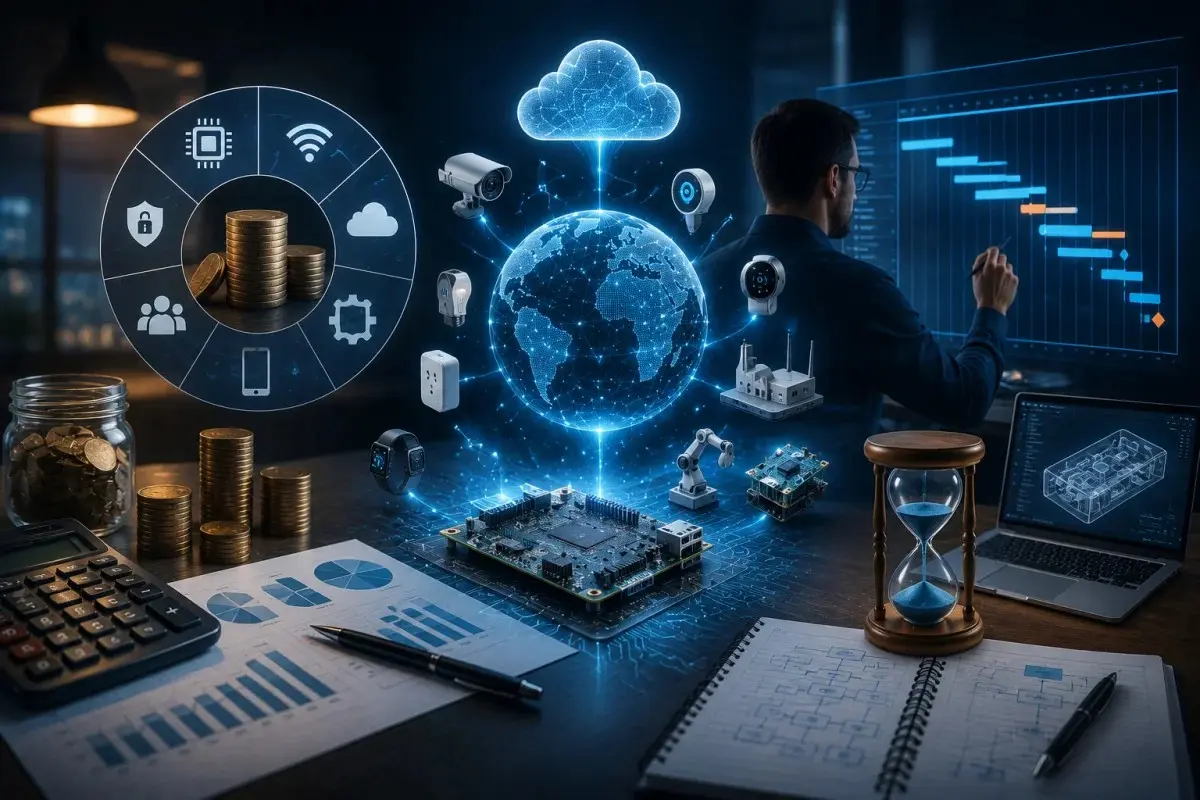
Understanding what drives the cost and duration of an IoT project helps businesses set realistic budgets and avoid unpleasant surprises partway through development. Because IoT projects involve multiple layers of technology working together, pricing and timelines tend to vary more widely than in traditional software development.
What Affects the Cost of IoT App Development
The overall cost of an IoT project is shaped by several interconnected factors, starting with the complexity of the hardware involved. A solution using off-the-shelf development boards will generally cost less than one requiring custom-designed circuit boards or specialized sensors built for a specific environment. The number of layers involved also plays a major role, since a project requiring firmware, cloud infrastructure, and a fully custom mobile app naturally demands more resources than a simpler solution with fewer moving parts.
Security requirements can also meaningfully influence costs, particularly for projects in regulated industries like healthcare, where additional testing, certification, and compliance add time and expense. The scale of deployment matters too, since a platform designed to support thousands of devices from the start requires more robust cloud architecture than a small pilot program, even if the core functionality looks similar on the surface. Finally, the choice between an in-house team and an outsourced development company significantly affects the cost structure, with outsourcing often reducing upfront hiring expenses while shifting costs toward project-based pricing.
Typical IoT Development Project Timelines
Timelines for IoT projects vary considerably depending on scope, but most follow a general pattern that moves from early prototyping through to full deployment. Initial prototyping and proof-of-concept work, where core functionality is tested using development boards and basic firmware, often takes a matter of weeks rather than months, since the goal at this stage is to validate ideas quickly rather than build a polished final product.
Moving from a working prototype to a production-ready solution typically takes considerably longer, often spanning several months, as this phase involves custom hardware design, thorough firmware development, cloud infrastructure setup, and full application development working together. Projects with strict regulatory requirements, such as those in the medical field, tend to have longer timelines due to the additional testing and certification steps involved. Businesses planning an IoT project should expect the full journey from initial concept to market-ready product to take anywhere from several months to over a year, depending on complexity and industry-specific requirements.
Common Challenges in IoT Development (and How to Solve Them)
Even well-planned IoT projects run into obstacles unique to connected technology, since combining hardware, software, and networking introduces complexities that rarely arise in traditional development work. Recognizing these challenges early allows teams to design solutions proactively rather than reacting to problems after deployment.
Security and Data Privacy
Security remains one of the most pressing challenges in IoT development, largely because connected devices expand the number of potential entry points a bad actor can exploit. Unlike a single application running on a secure server, an IoT solution might involve hundreds or thousands of individual devices deployed in the field, each a potential vulnerability if not properly secured.
Addressing this challenge requires building security into every layer of the system from the start rather than treating it as an afterthought. This includes encrypting data both in transit and at rest, implementing strong device authentication, and designing firmware update processes that allow vulnerabilities to be patched quickly after devices are already deployed. Regular security audits and penetration testing throughout development, rather than only before launch, also help catch weaknesses before they become real-world problems.
Device Interoperability
Interoperability challenges arise when devices from different manufacturers that use different communication protocols need to work together within the same ecosystem. This is especially common in smart home and industrial settings, where a business or consumer may want devices from multiple brands to communicate seamlessly, even when they were not designed with that goal in mind.
Solving this challenge often involves adopting established communication standards where possible, rather than relying entirely on proprietary protocols that limit compatibility. Building flexible middleware that can translate between different device languages also helps bridge gaps between systems not originally designed to work together, enabling a more cohesive user experience even when the underlying hardware varies widely.
Scalability
Scalability challenges typically emerge as an IoT solution grows from a small pilot program to a full-scale deployment involving thousands or even millions of devices. A cloud architecture that performs well with a hundred connected devices can struggle significantly once that number grows by several orders of magnitude, particularly if the underlying infrastructure was not designed with that growth in mind from the beginning.
Planning for scalability early, even during initial architecture decisions, helps prevent costly rebuilds later in a project’s lifecycle. This includes choosing cloud infrastructure capable of handling large volumes of simultaneous device connections, designing data pipelines that can process increasing volumes of data without bottlenecks, and building device management systems that can handle firmware updates and monitoring across a large and constantly expanding fleet.
Frequently Asked Questions
What does an IoT developer do?
An IoT developer builds the systems that allow physical devices to collect data, connect to networks, and communicate with software applications, making them a central part of any IoT development project. Depending on their specialization, an IoT developer might write firmware that runs directly on hardware, build the cloud infrastructure that processes incoming device data, or develop the mobile and web applications that let users interact with connected devices. Many IoT developers work across several of these areas, since a strong understanding of how each layer affects the others is often necessary to build a solution that functions reliably as a whole.
How much does IoT app development cost?
The cost of IoT app development depends heavily on the project’s complexity, including the type of hardware involved, the number of technology layers required, and whether the solution needs to support a small pilot group or a large-scale deployment. Projects using standard development boards and simpler app functionality generally cost less than those requiring custom hardware design, advanced security measures, or integration with existing enterprise systems. Businesses are often better served requesting a detailed quote based on their specific requirements rather than relying on general estimates, since two projects that sound similar on the surface can differ significantly in actual cost once technical details are considered.
How long does IoT development take?
Most IoT development projects move through distinct phases, starting with prototyping that can take just a few weeks, followed by a longer development period that brings the product to a production-ready state. This second phase often takes several months, since it involves custom hardware work, thorough firmware development, cloud setup, and application development, all coordinated with one another. Projects involving strict regulatory requirements or highly complex integrations tend to take longer, sometimes extending the full timeline from concept to launch beyond a year.
Can I develop an IoT device myself?
It is possible to pursue IoT development independently and build a basic device, particularly given the widespread availability of development boards and kits that simplify early prototyping. Many hobbyists and small teams successfully complete simple IoT development projects, such as sensor-based monitoring tools, using accessible hardware and open-source resources. However, moving from a working prototype to a secure, scalable, production-ready product typically requires expertise across multiple disciplines, including embedded systems, cloud architecture, and application development. As a result, many individuals and businesses eventually turn to experienced IoT development companies once a project grows beyond its initial proof-of-concept stage.