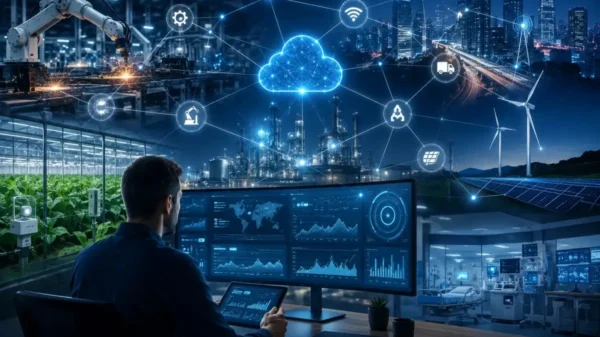
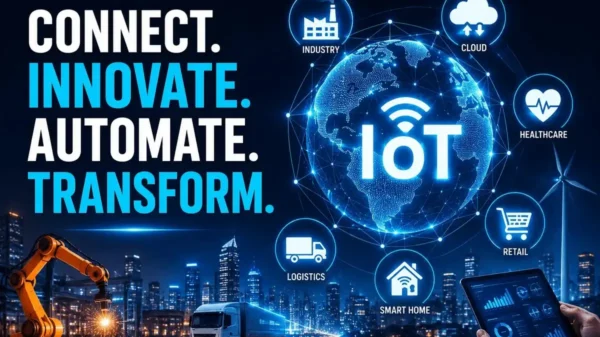
The Internet of Things (IoT) Technology has completely transformed how we interact. It has paved the way for smart homes, connected devices, and enhanced automation. As we look towards the future, the development of IoT continues to evolve, bringing forth new trends and advancements. In this article, we will explore the future of IoT development, delve into the key trends to watch out for, and discuss the importance of IoT security and IoT development software.
What is IoT?
The Internet of Things (IoT) is a network that connects physical devices, vehicles, buildings, and other objects. These objects have embedded sensors, software, and network connectivity to collect and exchange data. These devices range from household and wearable devices to complex industrial machinery and infrastructure. The data gathered by IoT devices can be analyzed and utilized to improve efficiency, automate processes, and enable intelligent decision-making. Connecting the physical and digital worlds, IoT has the potential to revolutionize industries, enhance convenience in daily life, and create new opportunities for innovation and growth.
The Future of IoT Development Trends to Watch
Edge Computing and IoT
Edge computing is another significant trend in the future of IoT development. Traditionally, IoT devices send data to a centralized cloud server for processing and analysis. However, with the increasing volume of data generated by IoT devices, transmitting all that data to the cloud can lead to latency and bandwidth issues. Edge computing addresses this challenge by performing data processing and analysis at the network’s edge, closer to the devices. This approach reduces latency, enhances real-time responsiveness, and minimizes the dependency on cloud infrastructure. Edge computing is particularly beneficial when immediate actions or decisions are required, such as autonomous vehicles and industrial automation.
Artificial Intelligence (AI) and Machine Learning (ML) in IoT
Integrating AI and ML with IoT is another significant trend to watch. By combining the power of AI and ML algorithms with IoT devices, we can unlock advanced analytics and automation capabilities. AI-powered IoT devices can learn from data patterns, make intelligent decisions, and adapt to changing environments. This convergence opens up possibilities, from predictive maintenance to personalized user experiences.
5G Connectivity for IoT
The deployment of 5G networks is poised to revolutionize IoT development. With its ultra-low latency, high bandwidth, and massive device connectivity, 5G enables seamless communication between IoT devices. It offers faster data transfer speeds, enabling real-time applications and unlocking the potential for massive IoT deployments. The widespread adoption of 5G will pave the way for more interconnected and intelligent IoT ecosystems.
Blockchain for IoT Security
IoT security has become a critical concern as more devices become interconnected. Blockchain technology is emerging as a robust solution to enhance IoT security. IoT devices can establish a secure and decentralized network by leveraging blockchain, ensuring data integrity and privacy. Blockchain provides a tamper-proof and transparent system that mitigates the risks associated with centralized data storage. As IoT devices continue to grow in numbers, blockchain-based security measures will play a crucial role in safeguarding sensitive information.
Edge AI and IoT Devices
Edge AI refers to the combination of edge computing and artificial intelligence, which is set to transform the capabilities of IoT devices. With the processing power of AI algorithms at the edge, IoT devices can perform complex computations and make intelligent decisions locally. This reduces the need for continuous data transmission to the cloud and enables real-time analysis and response. Edge AI empowers IoT devices to become smarter, more efficient, and more autonomous.
Energy Efficiency and Sustainability in IoT
The need for energy-efficient and sustainable solutions becomes paramount as the IoT ecosystem expands. IoT devices consume energy, and their increasing numbers can strain resources. The future of IoT development will focus on creating energy-efficient appliances that minimize their ecological footprint. This involves optimizing power consumption, implementing renewable energy sources, and designing IoT solutions to contribute to a greener and more sustainable future.
Interoperability and Standardization
Interoperability and standardization are essential for the seamless integration of IoT devices from various manufacturers. As the IoT landscape diversifies, ensuring that devices can communicate and work together becomes crucial. The future of IoT development will prioritize the establishment of common standards and protocols to enable interoperability. This will allow for easier device management, data sharing, and collaboration between IoT platforms.
IoT Security Protecting the Future
IoT security is of utmost importance as interconnected devices continue to rise. The vulnerabilities in Internet of Things networks can lead to data breaches, privacy concerns, and even physical risks. Implementing robust security measures is essential to protect IoT ecosystems. Some critical practices for IoT security include:
Importance of Authentication and Encryption
Authentication and encryption play a vital role in IoT security. Authentication ensures that only authorized devices can access the network, preventing unauthorized access and potential attacks. Encryption, however, protects data transmitted between devices by encoding it in a way that can only be decoded by authorized recipients. Implementing strong authentication and encryption protocols is crucial for maintaining the integrity and confidentiality of IoT data.
Regular Software Updates and Patching
Software updates and patching are critical for IoT security. Manufacturers must provide regular updates to address security vulnerabilities and bugs discovered in their IoT devices. Likewise, users must promptly install these updates to protect their devices from potential threats. Additionally, patching known vulnerabilities in IoT development software is essential to minimize the risk of exploitation by cybercriminals.
Network Segmentation and Access Control
Network segmentation involves dividing an IoT network into distinct segments, each with its security controls and access permissions. By segregating devices based on their functions or levels of sensitivity, potential attackers are restricted in their ability to move laterally within the network. Role-based access control (RBAC) is an example of an access control mechanism that helps enforce the principle of least privilege, ensuring that each device or user can only access the resources necessary for their intended purpose.
IoT Development Software
IoT development software enables developers to effectively create, deploy, and manage IoT applications. With the complexity and scale of IoT projects, developers need robust tools and frameworks to streamline their development process. Some popular IoT development software includes:
Arduino
Arduino is an electronics platform that is open-source and designed to simplify the process. IoT development. It offers a range of programmable microcontroller boards and a user-friendly integrated development environment (IDE). Arduino’s vast community and extensive documentation This option is great for both newcomers and seasoned developers.
Raspberry Pi
Raspberry Pi is a credit-card-sized computer that can be used as the brain of IoT projects. It provides a complete computing experience and offers GPIO (General Purpose Input/Output) pins for connecting and controlling external devices. Raspberry Pi supports various programming languages, making it versatile and accessible.
TensorFlow
TensorFlow is an open-source machine learning framework widely used in IoT applications. It allows developers to build and train AI models, enabling intelligent data processing and decision-making within IoT systems. TensorFlow’s flexibility and scalability make it a valuable tool for implementing AI-driven IoT solutions.
AWS IoT Core
AWS IoT Core is a managed cloud service by Amazon Web Services (AWS) that simplifies the development and management of IoT applications. It provides a secure and scalable infrastructure for connecting, managing, and exchanging data with IoT devices. AWS IoT Core offers various features, such as device management, data processing, and integration with other AWS services.
Microsoft Azure IoT
Azure IoT is a comprehensive cloud-based platform that enables seamless integration and management of IoT devices and data. It offers robust security features, real-time analytics, and scalable solutions for IoT applications.
Google Cloud IoT Core
Google Cloud IoT Core is a fully managed service that simplifies the deployment and management of IoT devices at scale. It provides secure device communication, data ingestion, and integration with Google Cloud services.
Conclusion
The future of IoT development holds immense potential for innovation, connectivity, and automation. As we embrace edge computing, AI integration, 5G connectivity, and blockchain security trends, we pave the way for a more interconnected and intelligent world. IoT security and efficient IoT development software are crucial to ensuring IoT technologies’ success and widespread adoption. By prioritizing security, fostering interoperability, and empowering developers, we can shape a future where the possibilities of IoT are realized, benefiting individuals, industries, and society as a whole.