The Internet of Things (IoT) has moved beyond being a futuristic idea — it is now a driving force behind digital transformation in homes, businesses, and cities. At the heart of this revolution lies IoT hardware, the physical devices and components that enable connectivity. Without robust sensors, gateways, and processors, even the most advanced IoT platforms or software solutions would be useless.
But what exactly is IoT hardware, and why does it matter? In this guide, we’ll explore the essentials of IoT hardware, its components, applications, challenges, and how AI tools supercharge its potential. If you’re entirely new to IoT, you may want to read this overview first: What is IoT?
What is IoT Hardware?
IoT hardware refers to the physical infrastructure that powers the Internet of Things. It includes:
- Sensors and actuators – the data collectors and responders
- Microcontrollers and processors – the computing brains
- Connectivity modules – Wi-Fi, Bluetooth, Zigbee, LoRaWAN, or 5G chips
- Gateways – devices that link local networks to the cloud
- Power systems – batteries, energy-harvesting, or wired power
In short, IoT hardware enables IoT devices to collect, process, and share data seamlessly.
 Core Components of IoT Hardware
 Core Components of IoT Hardware
1. Sensors and Actuators
Sensors are the “eyes and ears” of IoT systems. They detect physical conditions like temperature, motion, or pressure. Actuators then take action — such as adjusting a thermostat or unlocking a smart door.
Example uses:
- Smart homes use motion sensors for security.
- Healthcare wearables track patient vitals.
- Factories deploy vibration sensors for predictive maintenance.
For a closer look at design principles, see the physical design of IoT.
2. Microcontrollers and Processors
Microcontrollers (MCUs), such as Arduino or ESP32, and processors, like ARM Cortex chips, are the computing cores. They process sensor data, run lightweight programs, and enable communication.
These factors matter most:
- Efficiency for battery-powered devices
- Processing capacity for complex tasks
- Scalability across networks
3. Connectivity Modules
IoT thrives on connectivity. Different applications require different modules:
- Wi-Fi for home devices
- Bluetooth for wearables
- Zigbee & Z-Wave for automation
- LoRaWAN for agriculture and logistics
- 5G for ultra-low latency
A critical enabler here is the IoT SIM card, which powers mobile-based IoT deployments, such as smart meters and fleet management.
4. Gateways
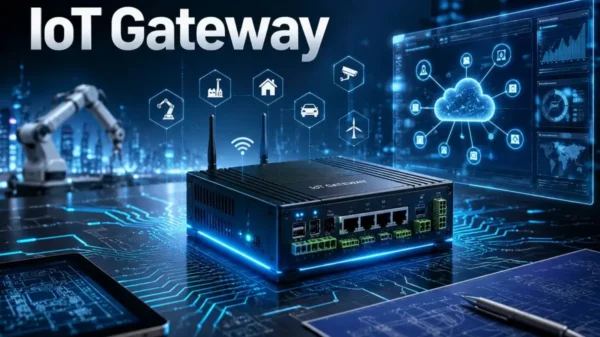
Gateways connect local IoT devices to the cloud, often handling security, edge processing, and traffic management.
- Smart cities use IoT gateways for connected streetlights.
- Factories adopt Fedora IoT routers for large-scale device management.
Learn more about managing devices at scale: Fedora IoT router device management.
5. Power Systems
Because IoT hardware often works in remote environments, power efficiency is critical. Solutions include:
- Low-power chips
- Solar and vibration-based harvesting
- Rechargeable batteries
Applications of IoT Hardware in Action
Smart Homes
- Smart thermostats optimize energy use.
- Security systems rely on sensors and cameras.
- Connected appliances communicate for efficiency.
Healthcare
- Wearables monitor real-time health data.
- Smart pill bottles ensure medication adherence.
- Remote diagnostics rely on IoT hardware to connect patients and doctors.
Industry 4.0
- Predictive maintenance reduces downtime.
- Sensors improve workplace safety.
- Robots powered by IoT hardware streamline production.
Discover how IoT impacts industries and cities: Explore IoT Smart Cities.
Smart Cities
IoT hardware powers urban innovation:
- Connected waste bins signal when they’re full.
- Bright traffic lights reduce congestion.
- Energy meters improve resource distribution.
Agriculture
- Soil moisture sensors guide irrigation.
- GPS trackers monitor livestock.
- IoT-enabled weather stations predict risks.
For long-term insights, check out IoT remote monitoring in 2025.
Challenges in IoT Hardware
- Security Risks – Devices are vulnerable if not protected. IoT remote monitoring plays a key role in spotting threats.
- Interoperability Issues – Proprietary standards can block device integration. Learn the difference between IoT and M2M.
- Power Limitations – Battery life is still a bottleneck.
- Scalability – Managing thousands of devices requires advanced platforms, such as an IoT control panel.
- Environmental Impact – The rise of IoT creates concerns around e-waste.
The Future of IoT Hardware
Future developments will focus on:
- AI at the edge – chips running ML models locally.
- Ultra-low-power designs – extending device life.
- 5G and beyond – faster, more reliable networks.
- Sustainability – recyclable and eco-friendly hardware.
Explore future possibilities: IoT cloud computing and Inter-IoT.
How AI-Powered Tools Enhance IoT Hardware
IoT hardware is powerful on its own, but AI tools elevate its impact:
- AI Website Builders – help IoT businesses build professional sites fast.
- AI Copywriting Tools – make technical IoT content accessible for customers.
- Automation Platforms – process IoT data into real-time workflows and analytics.
- Chatbots & AI Assistants – support users with IoT troubleshooting 24/7.
For software solutions, compare leading platforms on Capterra IoT software.
Conclusion
IoT hardware is the foundation of our connected world. From smart homes to industrial automation and entire smart cities, the physical layer of IoT ensures that digital intelligence can operate in real time.
Businesses that combine strong IoT hardware with AI-powered automation, cloud computing, and monitoring solutions gain an edge in efficiency and innovation.
Frequently Asked Questions (FAQs)
1. What is IoT hardware?
IoT hardware refers to the physical components of the Internet of Things, including sensors, actuators, processors, gateways, and connectivity modules. These devices collect and process data, enabling real-time communication between systems. For a comprehensive breakdown, see ‘IoT devices explained’.
2. Why is IoT hardware critical?
Without IoT hardware, the entire IoT ecosystem would not function. Hardware provides the sensors, chips, and gateways that collect and transmit data, forming the foundation for smart homes, healthcare, industry, and IoT smart cities.
3. What are the main types of IoT hardware?
The core categories of IoT hardware include:
- Sensors and actuators
- Microcontrollers and processors
- Connectivity modules (Wi-Fi, Bluetooth, 5G, LoRaWAN)
- IoT gateways
- Power systems
Each category plays a unique role in enabling devices to function within the IoT network. Explore the physical design of IoT to see how these components fit together.
4. How is IoT hardware different from M2M devices?
While both IoT and Machine-to-Machine (M2M) devices involve connectivity, IoT hardware usually connects to cloud platforms, integrates with AI tools, and supports large-scale interoperability. M2M, on the other hand, focuses on direct device-to-device communication. Learn more in this guide: the difference between IoT and M2M.
5. What challenges does IoT hardware face?
IoT hardware comes with challenges such as:
- Security vulnerabilities
- Power limitations
- Interoperability issues
- Scalability for large networks
- Environmental sustainability concerns
Advanced solutions, such as IoT remote monitoring and IoT control panels, help overcome many of these challenges.